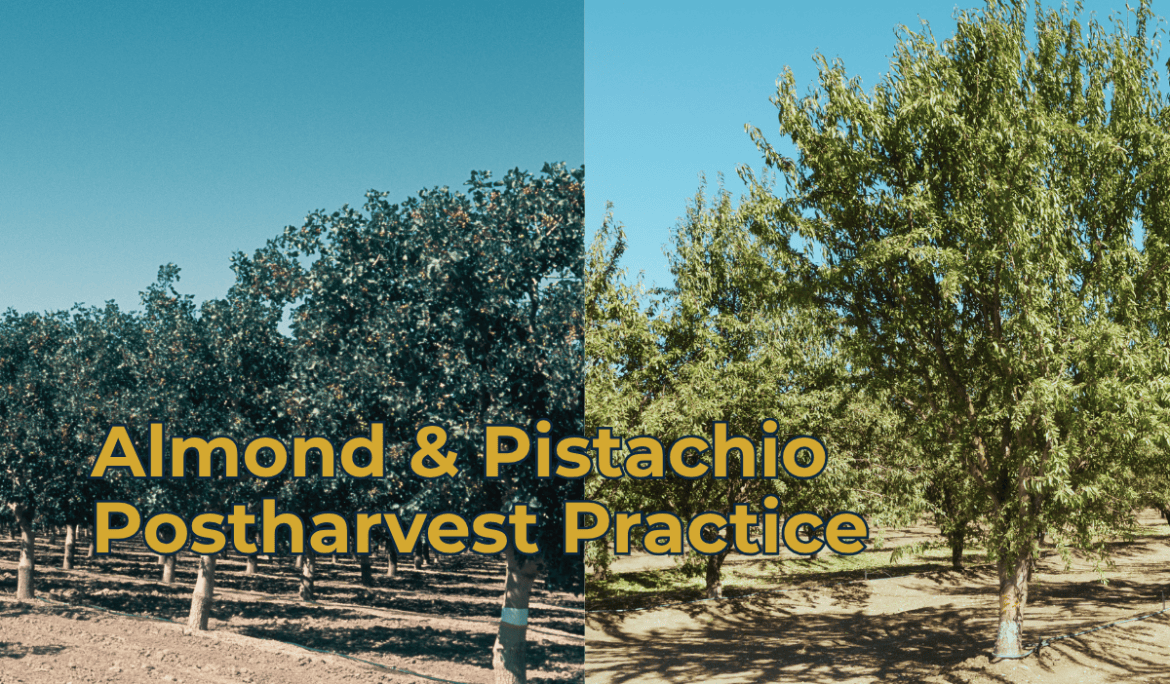
Pistachio and Almond Postharvest Practices

Postharvest Nutrition in Almonds and Pistachios

Why this Window Still Matters, Even in a Light Year

If you’re an almond or pistachio grower, harvest wrapping up usually means one more decision before you can exhale: what, if anything, to do about postharvest nutrition. This year that decision comes with a few extra wrinkles. Hull samples in a lot of almond blocks are coming back low on boron and nut size is small. Pistachios had a light crop with more blanks than usual. After a season like that, it’s tempting to call postharvest a wash and worry about it next spring. There is a case for doing that, but it’s not the best choice for your trees’ future. Let’s get into what goes on in almonds and pistachios postharvest and important things to think about.

Do trees really stop taking up nutrients after October 1st?

No. This is one of those rules that gets repeated so often it starts to sound like agronomy, but it doesn’t hold up against what’s actually happening in the orchard. Temperatures can still push toward 100°F well past October 1st in a lot of growing regions in California. If a tree is still pulling water — and at those temperatures, it is — it’s still capable of pulling nutrients along with it and storing them for winter. Sure, uptake generally slows as the tree moves toward dormancy, but “slows” and “stops on a calendar date” are two very different things. The tree doesn’t check a calendar; it responds to conditions. That’s the whole argument for feeding postharvest instead of waiting and hoping bloom sorts itself out.

Why postharvest nutrition still matters in a light pistachio year

A lot of pistachio growers took a lighter crop this year, with more blanks than usual. That’s most likely tied to heat during pollination and early embryo development. But a light crop doesn’t mean a light nutritional need. If anything, the tree has less to show for what it spent this year and needs a solid recovery window before it starts building next year’s crop. Skip postharvest nutrition after a rough year, and you risk starting bloom already behind on the nutrients that drive it. That matters more than usual right now: 2027 is shaping up to be a heavy bloom year, and proper postharvest feeding this fall is what sets up strong bud and bloom nutrition for it. It’s a lot easier to feed the tree now, while it’s actively taking up and storing nutrients, than to overcorrect a deficiency once bloom is already underway.

Almonds: correcting low boron for next year

If your nut sizes are down and your hull samples are coming back low on boron, the fix isn’t a single application, it’s timing two of them around what the tree can actually use. The first is a postharvest fertigation pass while ET is still active. Boron applied through the irrigation system while the tree is still pulling water gets into the root zone and into the tree, not just onto the surface. The second is a pre-bud or bloom foliar spray, which catches the tree again right before it needs boron most for pollen tube growth and fruit set. Worth considering if you’re not already doing it: split your postharvest fertigation into two passes instead of one. A pass right after the nonpareils come off gets nutrients to the most valuable trees earlier, while ET is still high and the tree is under real harvest stress. That earlier timing helps the tree start recovering sooner instead of waiting for the whole orchard to come off before nutrition shows up.

Why postharvest foliar sprays alone don’t get the job done

We’ve made this case directly to growers this fall, and it’s worth repeating here: a postharvest foliar-only application has limited value on its own. By this point in the season, leaves are dusty, tired, and already hardening off for winter and their ability to absorb nutrients drops off fast. Add a full canopy in the way, and even a well-timed spray struggles to reach the fruiting spurs and buds where it would actually help next year’s crop. Trees aren’t mobilizing nutrients the same way postharvest as they are earlier in the season, so a foliar pass at this stage is often more about habit than outcome. A pre-bloom or pink bud foliar spray solves that problem since there’s no leaf canopy competing for the material, so it goes straight to the spurs and buds that become next year’s crop. That’s why the boron correction above pairs a postharvest fertigation pass (root uptake, while the tree is active) with a pre-bud spray (direct delivery, no canopy in the way) instead of leaning on a foliar-only postharvest program.

What delivers postharvest nutrition best

Continuous fertigation is built for exactly this kind of timing problem. Instead of one slug application that has to land in a narrow window, nutrients move through the irrigation system continuously, adjusting to what the tree needs as conditions change — postharvest, into dormancy, and through next year’s bud development. That’s the same spoon-feeding idea researchers have recommended for years: match nutrition to actual plant demand instead of guessing at a single big dose. The DPG White Box™ is what makes that automatic, instead of one more thing to track during a season that already has enough moving parts. The White Box™ is the best delivery mechanism for postharvest nutrition, full stop — but it’s not the only way to get nutrients to your trees this fall. Deerpoint’s standalone nitrogen, potassium, and Potassium Plus™ products are built for growers applying their own program. Potassium Plus is worth a look if boron isn’t your only deficiency this year: a highly concentrated, highly available potassium source (0-0-28.3 Kâ‚‚O) built on patented potassium formate chemistry. Because it’s more concentrated, you’re shipping and applying less water to deliver the same amount of available potassium — which helps on cost as much as precision. On the White Box™ system, potassium fits into a prescriptive fertility plan the same way boron or nitrogen does — it runs simultaneously with other products, in custom amounts, adjusted pass to pass. You’re not locked into a fixed blend because a program was built that way once. It adjusts as your trees, and your sample results, tell you it should.

The bottom line

A rough pistachio year and low boron in almond hulls both point to the same conclusion: this is not the year to skip postharvest nutrition. Trees are still taking up nutrients as long as they’re taking up water, foliar sprays alone won’t reach where the tree needs them at this stage, and 2027’s heavy bloom outlook makes getting this right now more valuable than usual. Better to feed the curve now than try to overcorrect at bloom.

Quick FAQs

Do almond and pistachio trees stop taking up nutrients after October 1st? No. Uptake continues as long as the tree is taking up water, which in many years includes weeks of near-100°F weather after October 1st. Uptake slows as trees move into dormancy, but it doesn’t stop on a fixed date. Should I skip postharvest fertilizer in a light pistachio crop year? No. A light crop, especially one caused by heat-related pollination or embryo damage rather than a pollination failure, doesn’t reduce the tree’s need to recover and store nutrients for next year. Skipping postharvest nutrition risks starting next spring’s bloom already behind. What’s the best way to correct low boron in almond hulls? A two-part approach: a postharvest fertigation pass while ET is still active, so boron reaches the root zone while the tree is actively taking up water, followed by a pre-bud or bloom foliar spray timed to pollen tube growth and fruit set. Is a postharvest foliar spray effective on its own for almonds? Not usually. By postharvest, leaves are hardening off and less able to absorb nutrients, and a full canopy blocks material from reaching the buds and spurs that matter most for next year. A pre-bloom or pink bud foliar spray, when there’s no leaf competition, is a more effective window for a foliar-only application. What is continuous fertigation and how is it different from a standard postharvest fertilizer application? Continuous fertigation delivers nutrients through the irrigation system in small, ongoing amounts matched to what the crop actually needs, rather than one or two large applications. It’s the delivery method behind Deerpoint’s White Box™ system and reflects the “feed the curve” approach to crop nutrition that university researchers have recommended for years. Ready to build a postharvest plan for your almonds and pistachios? Get a free on-site consultation with a Deerpoint Group advisor: https://deerpointgroup.com/request-a-consultation/

Leave a Reply